|
|
The Second Clock |
|
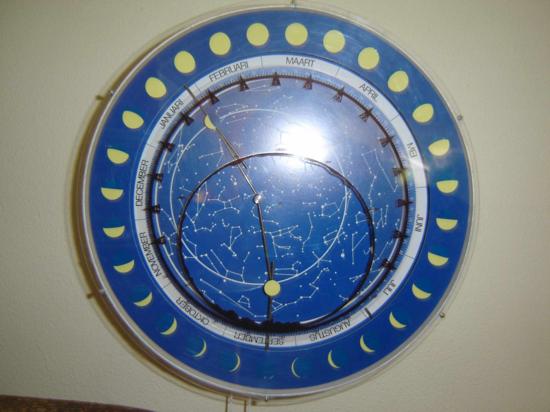
The second Clock shows also
the Moon. Sun and Moon are moving in the Ecliptic. In reality the
Moon can be up to 5 degrees above and below the ecliptic. The place
where the Moon crosses the ecliptic is called a lunar node . The lunar nodes are the
points where the Moon crosses the ecliptic (which is the apparent
path of the Sun across the heavens, against the background stars).
The ascending node is where the moon crosses to the north of the
ecliptic. The descending node is where it crosses to the south.
The Sky is moving in 23h 56m 3.934428s, should be 23h 56m 4.0905s.
(Difference daily 0.156072s)
In this clock the Synodic Moon moves in mean time. (24h 50m 28,3783776s)
should be 24h 50m 28.3286526s. (Difference daily 0.049725s) The
disc of the Sun covers the difference between mean and real Sun.
Because the Moon moves in a elliptical path around the earth, the
time it takes is always different. The length of the mean synodic month (New
Moon to New Moon) is 29.530588 days (=29d12h44m03s). (But the length
of the synodic month can vary from 29.26 to 29.80 days due to perturbing
effects of the Sun on the Moon's eccentric orbit)
At the photo it
is almost full Moon. The month is September. Every day the
Sun will be a little lower above the horizon. In fact there is a
lot more to see!
|
Photos of the
wheel trains
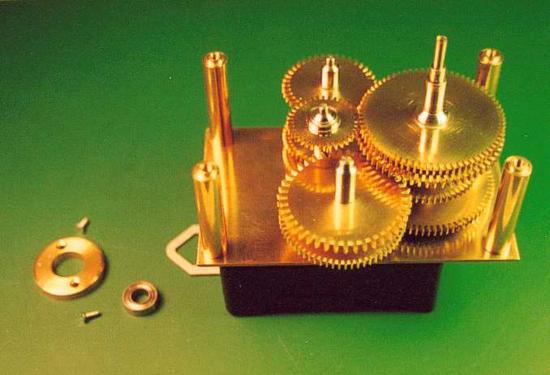
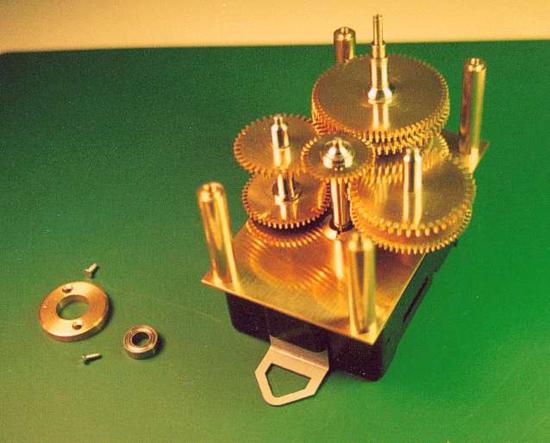
|
|
|
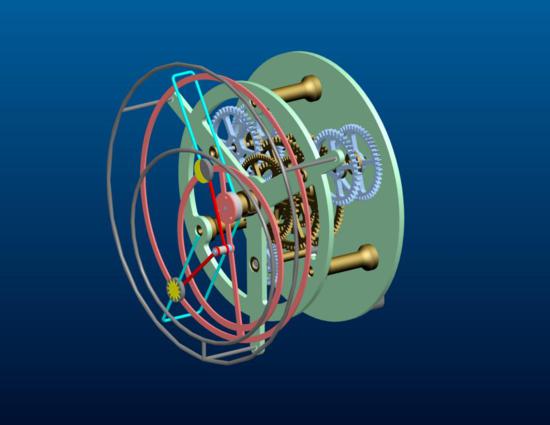
These
nice 3D computer drawings are made by Peter Held, thank you for the contribution
Peter!
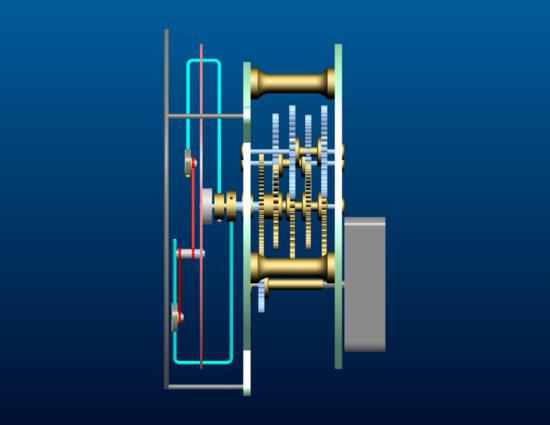
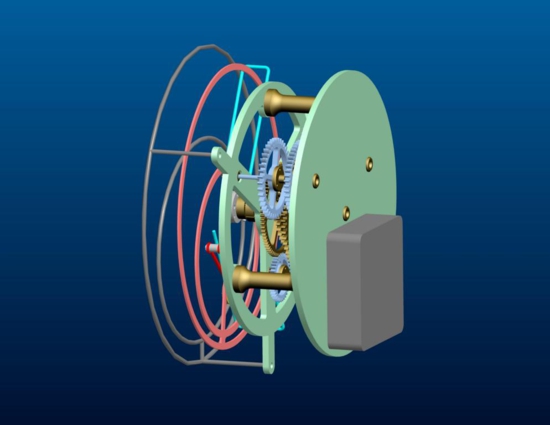
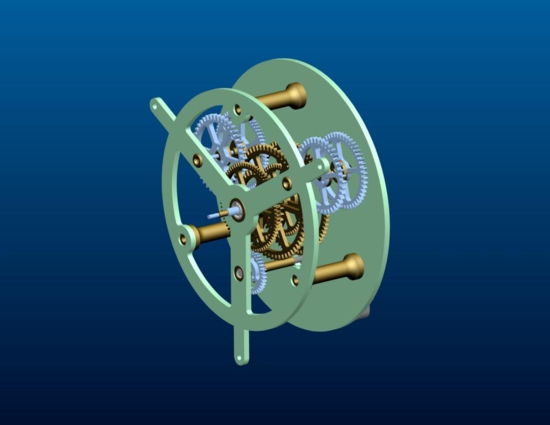
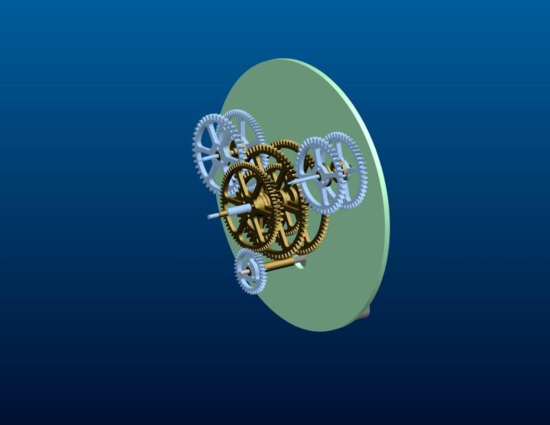
The
original first Drawings??
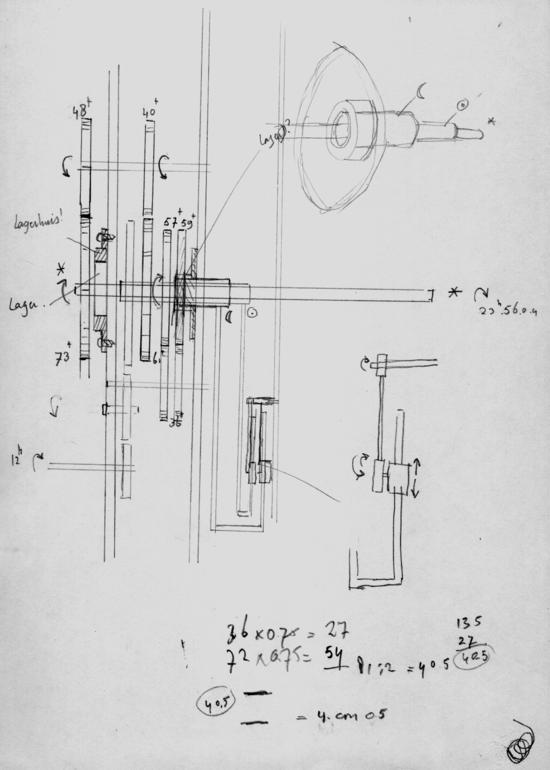
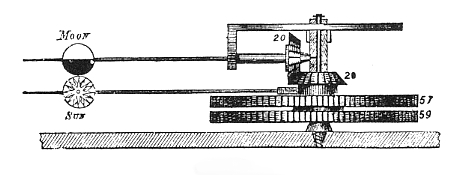
On this design
from 1998 two wheels that engage the 57/59 wheels, use the same number of teeth
-36-
but then they are consequently a little out of pitch when you only have a cutter
with full Module like M 0.75 or M 0.8
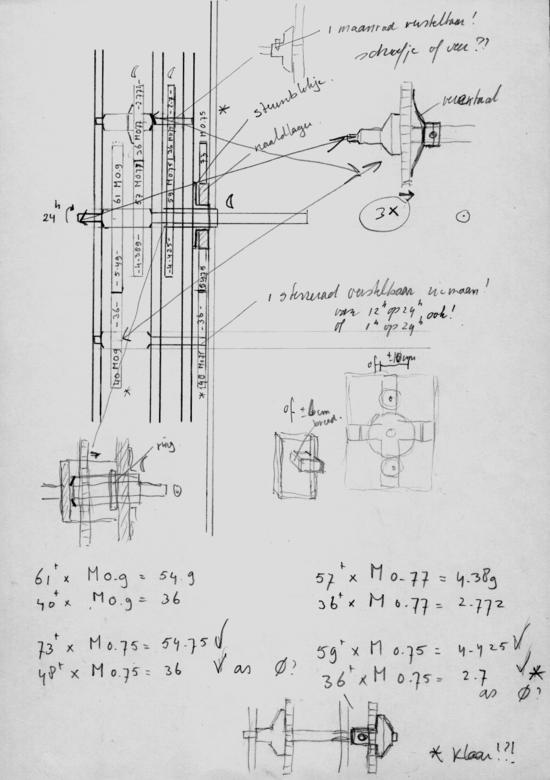
Recently I found a better design
from 2000 with the wheels (synodical Moon) 43/37 x 57/64 x 24 = 24.841216216
24h 50m 28,3783776
(In geocentric view it would have been better to place the Moon in front of
the Sun)
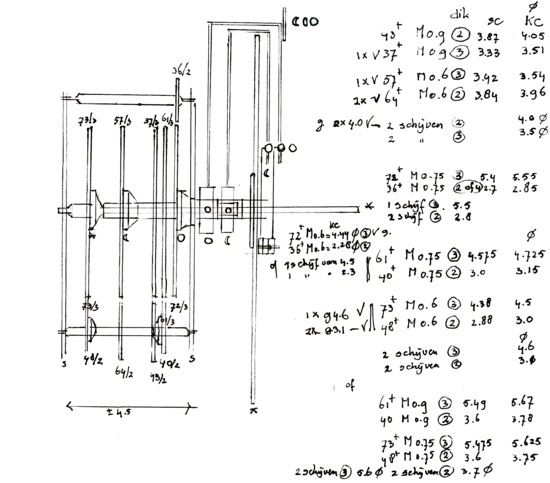
(Many gear combinations
can be found in books, others with software like -Gearfind- (Links page- Utilities/
(Bevel) gear software/ Tips))
Using Continued Fractions is also possible (Links page)
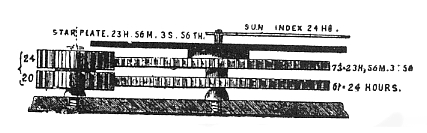
Some years later I bought Britten's
handbook and found the same gear combinations,
calculated by Ferguson 1710-1776. Eise Eisinga used the combination 20h x 73/61
To
the main page
